EFT Tapping: the complete technique, step by step
EFT tapping is a self-help technique in which you name what is currently on your mind and, while doing so, tap a fixed sequence of points on your body with your fingertips. You approach a distressing topic gradually, only ever as close as feels comfortable to bear. The name stands for Emotional Freedom Techniques, and the method is sometimes called tapping acupressure. This page shows the standard round, the way EFT is most commonly tapped today: the setup statement, the nine points of this round, and one full pass from start to finish. You can do it all along as you read. Gary Craig’s original recipe also included the finger points and the so-called 9-Gamut procedure; for everyday use, the short form shown here has become standard.
What EFT is — and what you have to believe for it to work
Nothing. EFT combines two simple things: you turn your attention to something that is bothering you, and you tap on certain points on the skin while doing so. The points come from acupressure, hence the name tapping acupressure.
There are explanatory models that speak of meridians and energy pathways, and there are more sober ones that point to the calming of a stress reaction. For the practice, both are secondary. Many people report that the tension a particular thought triggers eases while they tap.
Where EFT comes from. EFT was developed in the 1990s by Gary Craig , an engineer trained at Stanford. He took an older, more complicated tapping method and simplified it into a single sequence that stays the same for every topic. His observation was plain: when you tap certain points while thinking of something distressing, the stress the topic triggers often eases — sometimes until it disappears entirely.
Said honestly: nothing works for everyone, and not every topic resolves on the first attempt. EFT is a tool, not a promise. The practical part is that it costs you nothing but about ten minutes to test on yourself: take a concrete annoyance or tension, measure its strength, tap at least one round, and measure again.
The setup statement
Every EFT round begins with a short sentence, the setup statement. It has two parts: you name honestly what is present, and you add a phrase of self-acceptance. The classic form is:
“Even though I have [the topic], I deeply and completely accept myself.”
For example: “Even though I get all jittery before this call, I deeply and completely accept myself.” You say the sentence three times while tapping the side of the hand (more on that shortly).
This second part has a reason. EFT assumes that a part of us sometimes resists the change — this is called psychological reversal; you could also think of it as an inner refusal or block. The self-acceptance phrase eases this resistance, so that the actual topic can be tapped on at all.
You don’t need to know the reason. A common misconception is that you first have to understand where something comes from. You don’t. If you only sense that something is there but don’t know why, that is a perfectly valid starting point:
“Even though I don’t know why this affects me so much, I deeply and completely accept myself.”
When you can’t name the feeling. Sometimes you can’t say at all what is there, only that the body reacts. Then take exactly that physical sensation as your way in:
“Even though I have this lump in my stomach, I deeply and completely accept myself.”
When “I accept myself” feels too far away. Not everyone finds “I deeply and completely accept myself” easy to say. For some it is hard with a particular topic, for others in general; and reciting the sentence as an empty formula, without feeling it, does little. Then take a phrase that still feels honest — for example:
“…still, I choose to accept myself.” · “…still, I’m okay as I am.” · “…still, I’m willing to be kinder to myself.”
The setup statement is not a rigid formula. Fill it with life, in whatever way feels true to you — the words have to fit you, not a textbook.
The nine tapping points
You tap with two or three fingertips, about seven to ten times per point, at a calm pace. Very gently, just noticeably; force plays no role here. The side doesn’t matter; use whichever hand comes easier, and feel free to switch. Points that exist on both sides (left and right) you can tap on one side, or with both hands on both sides at once.
EFT is not a matter of millimetre-precise point-finding. Unlike acupuncture with needles, it doesn’t depend on the exact spot — with two or three fingertips (or the whole hand at the collarbone) you’ll hit the region anyway. So don’t stress about landing precisely on a spot; it’s enough to tap somewhere in the area we describe here.
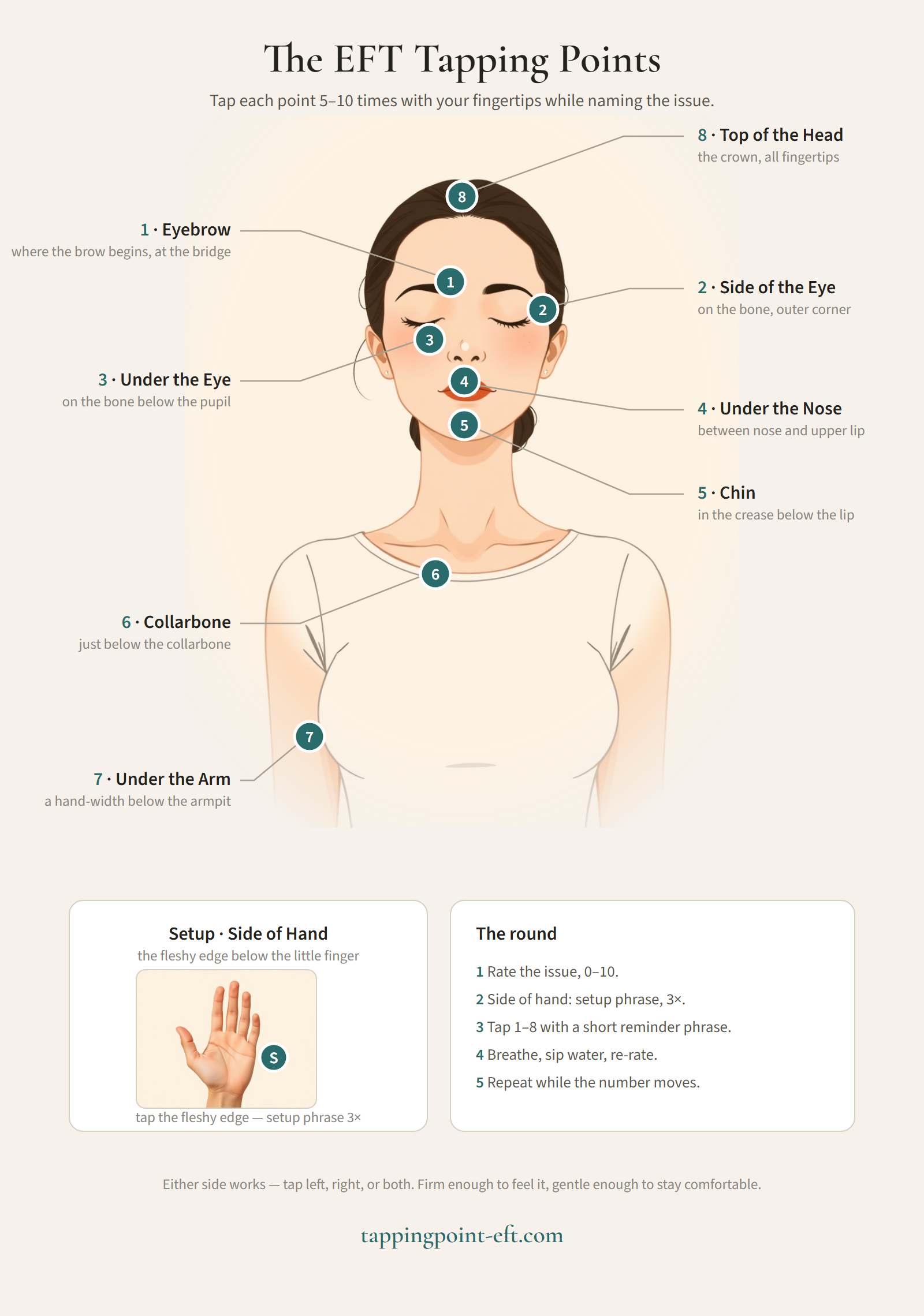
The first point belongs to the setup statement; the eight that follow make up the round itself.
Setup point — the side of the hand. The soft outer edge of the hand below the little finger, the part you’d use for a karate chop. Here you tap while saying the setup statement three times.
P1 — eyebrow point. At the inner start of the eyebrow, directly above the inner corner of the nose. Not at the outer end of the brow, but inside, where it begins.
P2 — side of the eye. At the outer corner of the eye there is the hard bone. Move from there a little outward toward the temple, and you’ll feel a small hollow where the temple begins. Tap there with two fingers — on the bone, not into the eye, of course.
P3 — under the eye. Below the eye, the hard bone of the eye socket begins. Move about a finger’s width down from there and you’ll feel a small hollow in the bone — you can search for that dip; that’s where the point is.
P4 — above the upper lip. In the small groove between nose and upper lip. Tap the skin above the lip, not the lip itself.
P5 — chin. In the crease between lower lip and chin, in the hollow below the lip.
P6 — collarbone. About two to three centimetres below the inner end of the collarbone, left and right of the top edge of the breastbone. If you feel the hard edge of the collarbone and then go a bit down and out, you’re in the right place. The area is large enough to hit easily with the flat hand: place the heel of your hand where the ribs meet at the top of the breastbone and tap loosely upward toward the shoulder — that way you’ll reach the point for sure. Some use a loose fist instead of the fingertips and tap gently.
P7 — under the arm. On the side of the body, about a hand’s width below the armpit. For women at the level of the bra band, for men at the same height on the side.
P8 — crown. On top of the head, on the crown, the soft point in the middle. Here you tap with several fingers or the flat hand in small circles in the centre.
One full round, step by step
Take a concrete topic. Not “my life”, but something tangible: the annoyance about an email this morning, the nervousness before a conversation, the tightness that comes when you think of a certain task.
Step 1 — measure. Bring the topic to mind briefly and estimate how much it burdens you right now. EFT borrows a simple measure for this, the SUDS — Subjective Units of Distress. You rate the inner stress on a scale from 0 to 10: 0 means no stress at all, 10 means as strong as you can imagine. Whether you use this scale or prefer to measure in percent makes no difference — take whatever comes more intuitively; “the stress is at 70 percent” is just as usable as “the stress is a 7.” What matters is only that you use the same yardstick before and after and note the starting value — without it you won’t notice later whether anything has shifted. In my experience, this simple measuring is a very good way to follow how the individual aspects of a topic change.
Step 2 — attune. Tap the side of the hand and say your setup statement three times. For example: “Even though I get restless at the thought of tomorrow, I deeply and completely accept myself.” The variants above apply here too: if you don’t know the reason, begin with “Even though I don’t know why this affects me so much”; if self-acceptance feels too far away, use one of the smaller phrases.
Step 3 — tap through the points. Go through P1 to P8 in order, seven to ten times per point. At each point, say a short reminder phrase that keeps you with the topic. It can be very plain: “this tightness”, “this annoyance”, “tomorrow morning”, “this thought”. You don’t have to phrase anything nicely. It is only about keeping your attention on the topic while you tap, and not drifting off.
Step 4 — breathe and measure again. After the round, take one conscious breath, and have a sip of water if you like. Then bring the topic back to mind, rate it again on the 0-to-10 scale, and note the new number.
Step 5 — repeat as long as the number falls. The aim is to tap the number down round by round, ideally to zero. As long as it drops, keep tapping and adjust the setup statement to whatever is left: “Even though there’s still a bit of tightness left…”.
If the number stops falling, you have two options. One: you deliberately stop at a 3, 2 or 1 and continue the next day — forcing it achieves nothing.
The other, often more interesting one: check whether you’re even still on the same topic. It often shifts unnoticed. The lump in your stomach is suddenly somewhere else, the body-feeling has changed. Or you’re no longer thinking of the teacher’s stern look but of how the class laughed. In that case you’ve already tapped the first aspect down to zero and are long since on another one.
That’s worth paying attention to: what you’re actually working on right now. Often you don’t notice the switch and wonder why the number rises again or won’t fall further — because technically you’re still tapping the old topic while your head is already on the new one. Then name the new aspect and tap on it.
A word on pace, which stands above the whole technique: EFT works slowly and gently. You go only as close to a topic as feels comfortable to bear. Often the edge of a topic is enough — the surroundings, the tension, the last concrete trigger. You don’t have to put yourself through the full force of something again in order to work on it — on the contrary, there is no benefit in diving deep into a topic. EFT approaches a topic more like an onion, layer by layer, always keeping it within a bearable range. If a feeling gets too strong, take a step back and get more general: stop tapping the sharpest detail and tap only on the topic as a whole, until the tension is bearable again. And if something threatens to overwhelm you, stop, keep tapping calmly on a neutral point, and let the topic rest for today — with strongly distressing memories, that’s the point where guidance makes more sense than going it alone.
The aspects of a topic — the table legs
What burdens us is rarely a single thing. Usually several aspects hang on a topic, which together keep it alive in us — each one feels a little different. Think of an unpleasant situation from school: the teacher who looked stern is one aspect; the class that started laughing, another. Both belong to the same topic, but each triggers tension on its own.
Gary Craig coined an image for this: he called these aspects the table legs. The topic is the tabletop, and each single aspect a leg that holds it up. You don’t have to move the whole top at once. You tap one table leg down after another — this one look, this one sentence, this one image — and at some point no leg holds any more, and the table collapses.
What often surfaces after a few rounds
When the first tension eases, something revealing often happens: a thought pushes forward that you hadn’t thought of before. A memory, another sentence, sometimes an image. “That’s like back when…”. Or a sober idea: “Actually, I could just ask.”
Write such thoughts down briefly — they’re often closer to the real topic than what you started with. This is how EFT works its way forward, layer by layer: you tap away the obvious, and underneath, what actually hangs on it becomes visible. So when such a thought surfaces, don’t stop; take it into the next round.
Common beginner questions
Do I have to keep the order exactly? The order shown is well established and easy to remember because it runs from top to bottom. If you swap or skip a point, nothing falls apart. More important than the perfect order is staying with the topic.
Left or right? Doesn’t matter. The points sit on both sides of the body, and both work. Take whatever’s comfortable.
How hard should I tap? Very gently — it’s enough if you feel the touch lightly. Force plays no role; it’s tapping, not hitting. On the face you naturally tap more softly than on the collarbone.
I feel silly doing this. That’s normal, especially at the start and especially when speaking out loud to yourself. You can also say the sentences quietly or only in your head. The feeling usually passes after the first few times, once you notice that something is happening.
How often? As often as you like. Many use it briefly and specifically in the moment something comes up.
Nothing’s happening. Most common cause: the topic is too general. “I’m dissatisfied” is hard to grasp. Get more concrete — take a single situation, a single sentence, a single image. Sometimes it’s also that another topic is in the way that would come first.
When you can’t get further on your own
EFT is meant as self-help from the start — you can explore a lot on your own, without training, without any device. Guidance becomes interesting above all with blind topics: where you notice you’re going in circles — when the same point comes back after every round, when something surfaces while tapping that you can’t place on your own, or when you sense that something is there but can’t get to what it’s actually about. Then an outside perspective helps. In a one-to-one session we work in a structured way on one topic, at your pace, plainly and down to earth.
A free, no-obligation introductory call (10 minutes) is enough to see whether the approach fits you.